
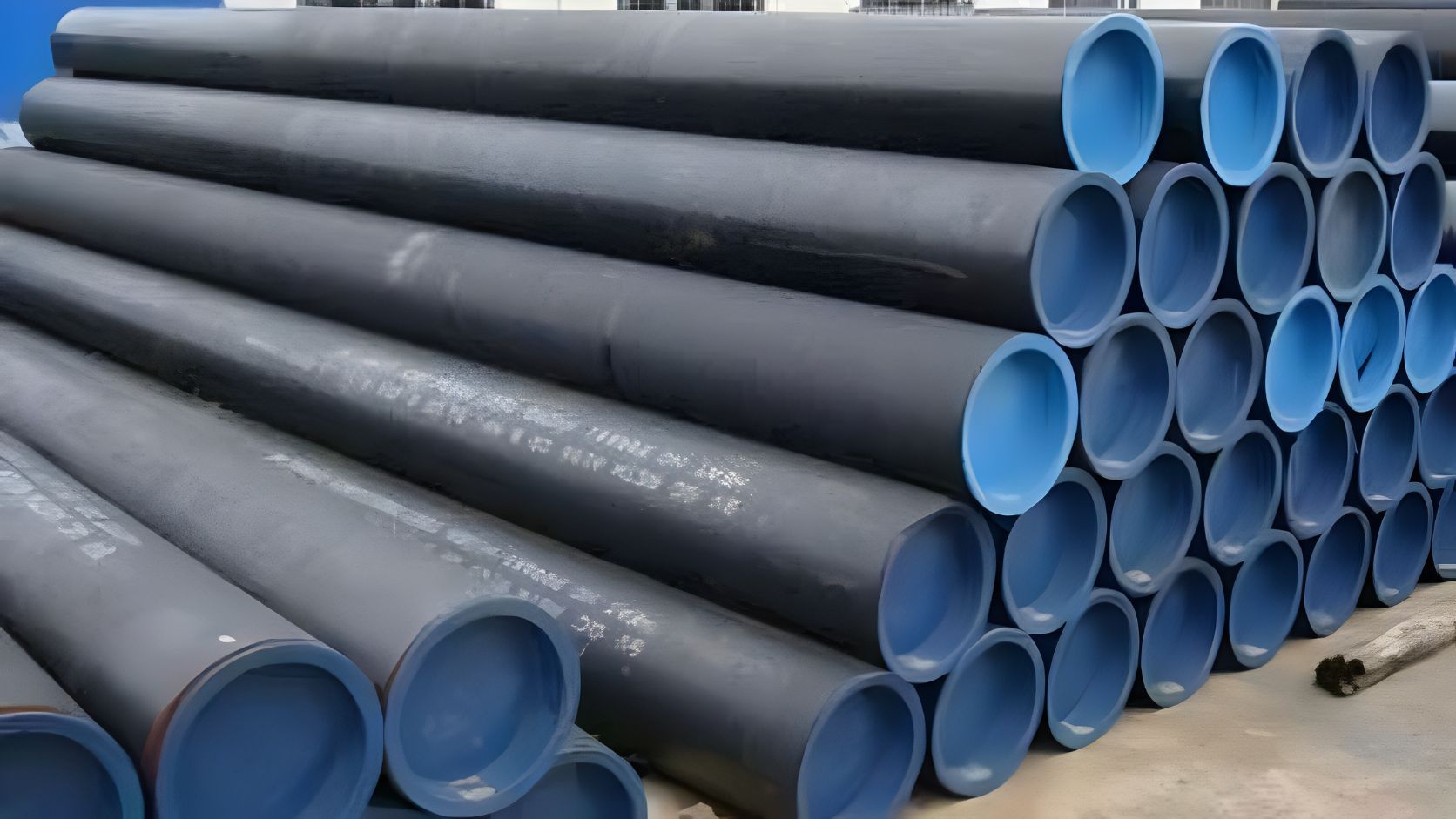
Procurement teams and design engineers frequently face this decision when selecting carbon steel piping for industrial projects. A carbon steel seamless pipe has no weld line running through it, which changes how it handles pressure, temperature swings, and vibration. A carbon steel welded pipe is built from formed plate or coil, joined along a seam, and that seam becomes the one feature every specification has to account for. Both types show up across oil and gas, power plants, water systems, and structural work. The right choice depends on pressure class, size, budget, and how the line will actually be used, not on which pipe sounds stronger on paper. This article walks through the manufacturing differences, where each type performs best, and how to match the pipe to the job.
What is a Carbon Steel Seamless Pipe?
A seamless steel pipe manufacturing process begins with a solid round billet. The billet is heated, pierced through the center, then rolled or drawn to the final diameter and wall thickness. No plate is rolled and welded shut, so there is no longitudinal seam. This absence of a weld seam is the main reason seamless pipes are chosen for demanding applications. It reduces concerns about seam integrity in critical service, which is why carbon steel seamless pipe is used in high-pressure boiler lines, hydraulic circuits, and oil and gas transmission. ASTM A106 and API 5L are the standards most often referenced for this product, and mills typically stock it in smaller and mid-range diameters rather than very large sizes.
What is a Carbon Steel Welded Pipe?
The manufacturing process begins with a flat plate or coil, which is rolled into a cylindrical shape and joined along a longitudinal or spiral seam. Electric resistance welding, or ERW, is the most common method for carbon steel in this category, producing a consistent, controllable seam when run correctly. Carbon steel welded pipe costs less to produce than seamless pipe because the raw material cost and manufacturing steps are simpler, and mills can produce larger diameters without the size limits that piercing and drawing impose. This makes welded steel pipe a practical fit for water lines, structural applications, and moderate-pressure piping where a fully seamless product isn’t required by the service conditions. ERW pipe availability and lead times are usually shorter too, which matters on large projects.
Carbon Steel Seamless Pipe vs Welded Pipe: Key Differences
The two pipe types diverge on manufacturing method, size range, pressure rating, and cost, and the table below lays out how each factor compares.
| Comparison Factor | Carbon Steel Seamless Pipe | Carbon Steel Welded Pipe |
| Pipe size range | Commonly available in smaller and medium sizes; large diameters are more limited and often special-order | Available across a wider size range, including large diameters where seamless is less practical |
| Pressure capability | Generally better for high-pressure/critical service because there is no seam discontinuity | Suitable for many standard and moderate-pressure services; modern welded pipe is reliable when properly manufactured and inspected |
| Installation method | Installed like normal pipe, but selection often favors critical lines where maximum integrity is needed | Installed like normal pipe; often preferred where easier sourcing and fabrication convenience matter |
| Joint strength | No seam joint, so strength is more uniform around the circumference | The weld seam is the key structural feature and must be controlled; seam quality strongly affects performance |
| Maintenance | Often lower seam-related maintenance risk because there is no weld seam to fail or corrode preferentially | Maintenance requirements depend on weld quality, inspection practices, operating conditions, and corrosion protection methods. |
| Typical applications | High-pressure piping, oil and gas, power generation, boilers, hydraulic service, and critical process lines | Water lines, structural pipe, low-to-moderate pressure systems, utilities, large-diameter pipelines, and cost-sensitive projects |
| Wall thickness consistency | Usually good overall uniformity, but some products can show thickness variation from the piercing/drawing process | Modern welded pipe can offer very consistent wall thickness; seam area remains the main control point |
| Dimensional accuracy/ovality | Good roundness and concentricity are typical, especially in quality-controlled seamless products | Also good, and often cost-effective for large sizes; ovality control depends on the welding/forming process |
| Surface finish | Often a bit rougher from hot-working or drawing, though finish can be improved by processing | Can be smooth and uniform, especially in ERW products; finish depends on mill process and coating |
| Length availability | Usually shorter standard lengths and more limited long-length availability | Often available in longer continuous lengths and broader stock lengths |
| Lead time/availability | Often longer lead time, especially for larger or special sizes | Usually shorter lead time and wider market availability |
| Cost | Higher cost due to more complex manufacturing | Lower cost and generally more economical |
Advantages of Carbon Steel Seamless Pipes & Welded Pipes
Each pipe type carries its own set of strengths, and the advantages below explain why engineers keep specifying both.
Advantages of Carbon Steel Seamless Pipes
The absence of a weld seam gives seamless pipe an edge in demanding service. Four points matter most.
Superior Pressure and Temperature Capacity: Without a seam, seamless pipe handles higher pressure and temperature more predictably. That’s why boiler feedwater lines and superheater tubing often use it.
Enhanced Corrosion Resistance and Leak Prevention: Weld seams can corrode or crack over time in cyclic service. Seamless pipe avoids those seam-related risks, with more uniform wall behavior throughout.
Structural Uniformity and Precision: Grain structure remains consistent because the pipe forms from one solid piece of steel, making it more predictable under stress, vibration, and thermal cycling.
High Tensile Strength: Seamless pipe generally withstands better tensile and burst loading, as there’s no seam interrupting the material’s continuity. This matters most in hydraulic lines and high-pressure gas transmission, where failure isn’t an option.
Advantages of Carbon Steel Welded Pipes
Welded pipe earns its place through economics and flexibility rather than raw pressure capacity. These four points cover why.
Cost-Effectiveness: Producing welded pipe from flat plate or coil is a simpler process than piercing and drawing a billet, and that lower production complexity shows up directly in unit pricing across most size ranges.
Wider Range of Sizes and Greater Availability: Large-diameter pipe is far easier to produce through welding, so projects needing 24 inches, 36 inches, or larger typically specify welded pipe by default. Mills also carry broader stock across standard sizes.
Faster Production and Shorter Lead Times: Rolling and welding plate moves faster than the piercing and drawing sequence requires. That speed shortens lead times on large orders, which matters when a project schedule is tight.
Suitability for Structural and Medium-Pressure Uses: Welded pipe handles structural loads, water distribution, and moderate-pressure systems without issue. Most of these applications don’t need seamless-level pressure ratings, so welded pipe is the more practical fit.
Seamless Pipe vs Welded Pipe for Different Industries
Industry requirements shift the balance between the two pipe types, and the table below breaks down where each one typically fits.
| Industry | Carbon Steel Seamless Pipe | Carbon Steel Welded Pipe |
| Oil & Gas | Preferred for high-pressure, high-temperature, critical transmission lines, well services, and sour/harsh service where seam integrity matters | Used for lower-pressure pipelines, gathering lines, utility piping, and less severe transport service where cost and availability matter |
| Power Generation / Boilers | Common for boiler tubing, superheater lines, steam service, and other high-temperature critical piping | Used for auxiliary systems, low-to-moderate pressure services, and non-critical plant piping |
| Chemical / Petrochemical | Better choice for aggressive, high-pressure, and high-temperature process lines and equipment | Suitable for general process utilities, secondary piping, and service lines with moderate conditions |
| Construction / Structural | Used where strength is important, but often more than needed for routine structural work | Widely used for structural members, scaffolding, supports, and general construction because it is economical and easy to source |
| Water / Wastewater | Used in demanding pumping or pressure applications, but not usually the first choice for standard utility networks | Very common for water distribution, drainage, and general utility pipelines because large diameters and low cost are advantageous |
| Automotive / Machinery | Used in engine, hydraulic, and high-stress mechanical applications where pressure and reliability are important | Used in exhausts, frames, and general tubular fabrication where cost and formability are important |
| Pharma / High-purity process | Chosen for critical pressure and cleanliness-related piping where integrity is essential | Used for non-critical utility lines and support piping; less common than seamless in critical high-purity duty |
| Large-diameter infrastructure | Less common because large sizes are more expensive and less available | Preferred because it is easier to produce in larger diameters and is more cost-effective |
Which Carbon Steel Pipe Should You Choose?
Matching pipe type to service condition comes down to pressure, temperature, size, and budget. The examples below cover the most common decision points.
High-pressure pipelines: Seamless pipe is the default here because there’s no seam to introduce a weak point under sustained high pressure. This holds across transmission lines and critical process piping.
Steam service: Thermal cycling stresses a weld seam more than it stresses solid material. Seamless pipe copes better with the repeated expansion and contraction that steam lines go through.
Boiler systems: High pressure combined with high temperature makes boiler tubing one of the most clearly seamless applications. Many plant specifications prefer seamless pipe for critical boiler applications.
Oil & gas: Critical transmission and well service lines lean toward seamless, while gathering lines and lower-pressure sections often run on welded pipe instead.
Structural fabrication: Welded pipe covers this need without the added cost of seamless production. Structural loads rarely require the pressure ratings seamless pipe is built for.
Water pipelines: Large diameters and cost control matter more than pressure rating in most water distribution networks, which is why welded pipe dominates this category.
Low-pressure utilities: Standard utility runs don’t need seamless-level performance. Welded pipe handles the load at a lower cost per foot.
Industrial process piping: The choice depends on what’s running through the line. Aggressive chemicals or high-pressure points toward seamless, while general utility service points toward welded.
Conclusion
Choosing between carbon steel seamless pipe and carbon steel welded pipe comes down to pressure rating, temperature, size requirements, and project budget rather than one type being universally better. Seamless pipe fits critical, high-pressure, high-temperature service. Welded pipe fits structural, utility, and large-diameter applications where cost and availability carry more weight. For projects requiring certified carbon steel piping, working with a supplier that provides consistent quality documentation and product availability helps reduce procurement risks. Eckhardt Steel supplies seamless and welded carbon steel pipes for industrial applications.