
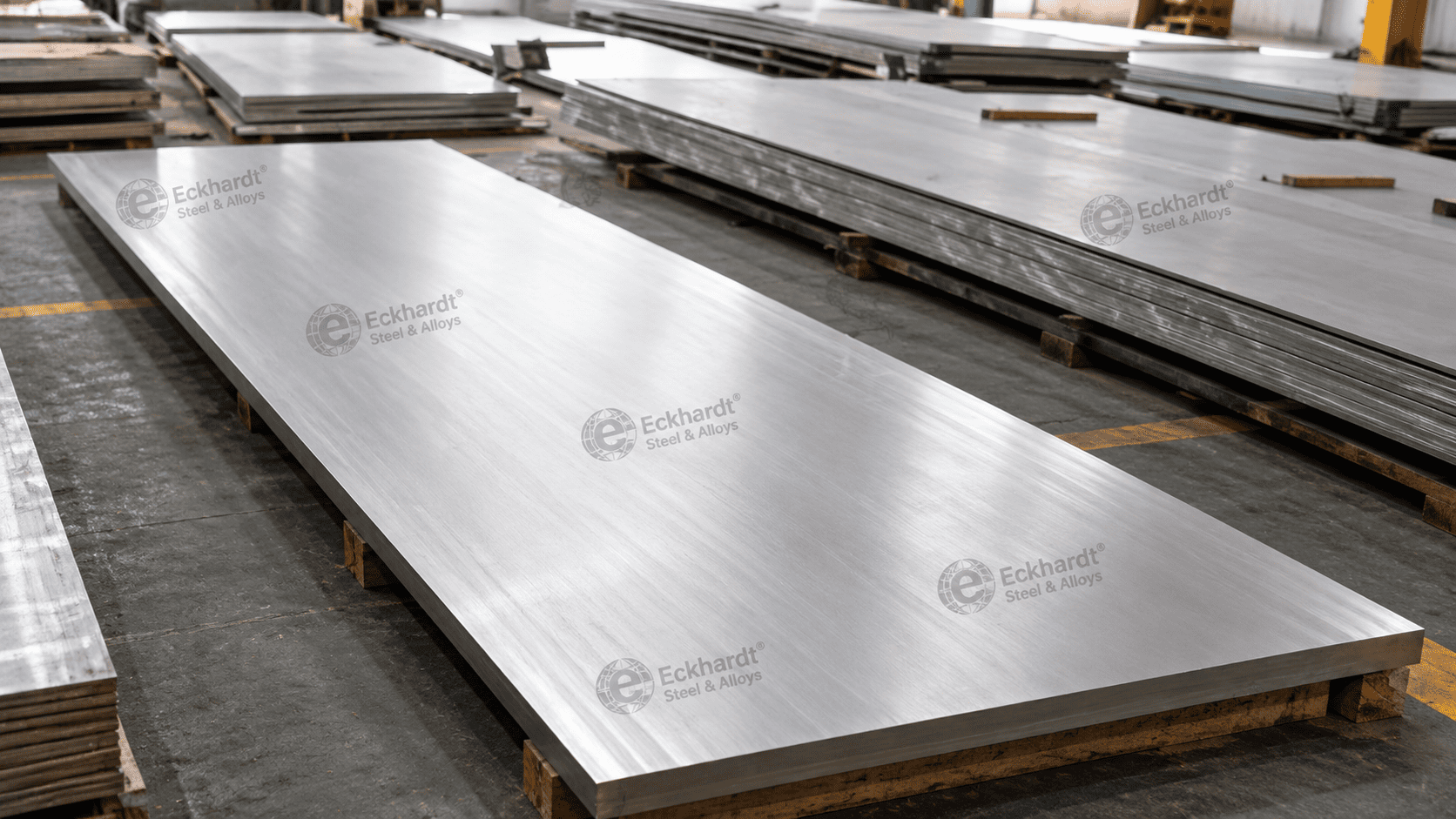
The choice between Hastelloy C276 and C22 depends on the chemistry of the service environment, not on a ranking of the two alloys. C276 handles mixed acid streams that swing between reducing and oxidising conditions. C22 carries more chromium, which strengthens it where oxidising species and chlorides dominate. Both sit at the top of the nickel alloy range, and Hastelloy plates in either grade serve chemical processing duty that stainless steel cannot sustain.
What Are Hastelloy C276 and C22 Plates?
Both grades belong to the nickel-chromium-molybdenum family, yet they differ in how the alloying elements are balanced. Hastelloy C276 contains roughly 15-17% molybdenum, 14.5-16.5% chromium and 3-4.5% tungsten, a combination that resists hydrochloric acid, sulphuric acid, chlorine and contaminated organic media. Hastelloy C22 raises chromium to 20-22.5% and holds molybdenum near 12.5-14.5%. Fabricators specify both in chemical processing equipment, reactors, heat exchangers, scrubbers and other corrosion-resistant components where a material failure stops the plant rather than slowing it.
Hastelloy C276 vs C22 Plates: Key Differences
The table below sets out the practical differences between the two grades across composition, corrosion behaviour and typical service. Both perform strongly; the distinction lies in which corrosion mechanism dominates.
| Parameter | Hastelloy C276 | Hastelloy C22 |
| UNS Number | N10276 | N06022 |
| Alloy Composition | Nickel-chromium-molybdenum with 3–4.5% tungsten | Nickel-chromium-molybdenum with 20–22.5% chromium |
| Oxidising Environments | Good resistance, with limits in strongly oxidising acids | Stronger resistance, supported by higher chromium |
| Reducing Acids | Excellent resistance in many conditions | Excellent resistance in many conditions |
| Pitting and Crevice Corrosion | Very high resistance | Particularly strong resistance in chloride media |
| Typical Applications | Chemical processing, reactors, heat exchangers | Chemical processing, pharmaceutical equipment, corrosive chemical systems |
Performance shifts with the chemical species present, its concentration, the operating temperature and the presence of impurities. Neither grade outperforms the other across every environment, and a small change in oxidiser content can reverse the ranking.
When Should You Choose Hastelloy C276 Plates?
C276 suits plants that push varied chemistry through the same equipment. Mixed acid streams, solvent recovery, pickling lines and flue gas desulphurisation all expose metal to reducing and oxidising attack within a single cycle. High molybdenum with a tungsten addition holds up against pitting, crevice attack and chloride stress corrosion cracking. Reactors, heat exchangers and process vessels built from Hastelloy C276 plates carry decades of recorded service in these duties. Confirm the selection against corrosion data for the actual stream before placing an order.
When Are Hastelloy C22 Plates a Better Choice?
Chromium drives the difference here. At 20-22.5%, C22 maintains a more stable passive film in oxidising media, so it performs well in nitric acid mixtures, ferric and cupric chloride solutions, and wet chlorine systems. Equipment facing chloride-induced pitting and crevice corrosion, such as brine handling lines and seawater-cooled coolers, is the usual case for specifying it. Pharmaceutical vessels and pollution control scrubbers often use Hastelloy C22 plates for the same reason. Higher chromium doesn’t guarantee a better result in every mixture, so verify behaviour at the real operating temperature.
How to Select the Right Hastelloy Plate Grade
Five inputs decide the grade. Start with the chemical type, its concentration and any impurities, since trace oxidisers can overturn a selection made on the primary acid alone. Record operating temperature and pressure next. Assess the risk of pitting, crevice corrosion and stress corrosion cracking around weld zones. Fix plate thickness, fabrication route and the governing specification, normally ASTM B575 for nickel alloy plates in both grades. Weigh material cost against expected service life, then check published corrosion tables before release.
Conclusion
C276 gives broad resistance across mixed corrosive streams, while C22 holds an advantage where oxidising species and chloride pitting dominate. Neither grade substitutes for the other. Match the alloy to measured process conditions rather than to general reputation. Eckhardt Steel & Alloys, an ISO-certified manufacturer, exporter and supplier based in Mumbai, stocks Hastelloy sheets and plates in both grades.