
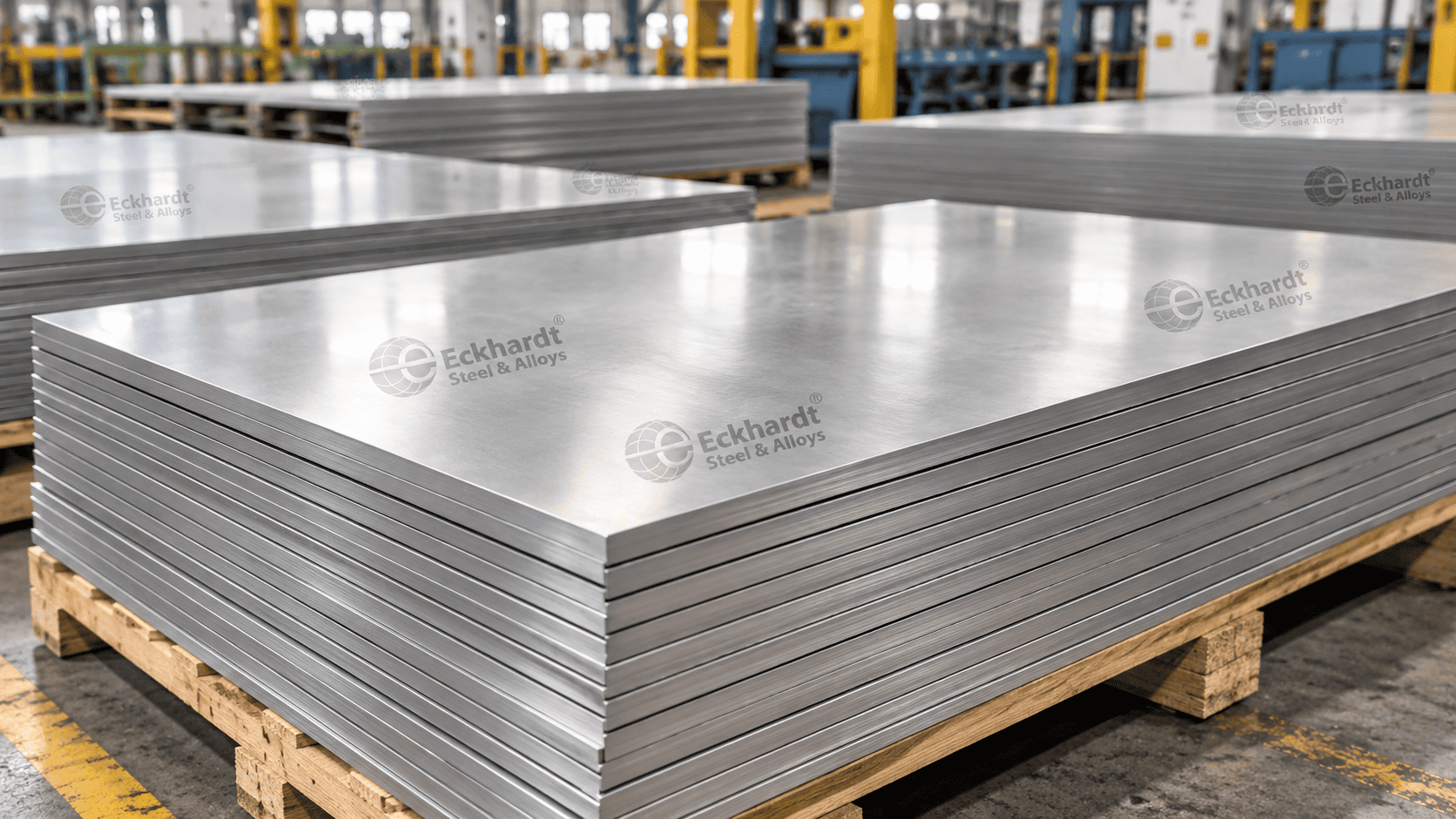
Materials that appear suitable in theoretical specifications often fail under actual seawater operational conditions. Chloride attack works through pitting, crevice corrosion and stress corrosion cracking, and each mechanism accelerates once deposits, stagnant pockets or raised temperatures enter the picture. Monel 400 performs better under direct seawater exposure, while 316 stainless steel suits milder marine conditions. Choosing between Monel plates and 316 plate depends on immersion time, flow velocity, water temperature and the maintenance access available.
What Are Monel 400 Plates and 316 Stainless Steel?
Monel 400 plates are rolled from a nickel-copper alloy with a minimum of 63% nickel and 28 to 34% copper. No chromium sits in the matrix. Protection comes from the nickel-copper structure, which stays stable in reducing conditions and in moving seawater where oxide films break down. 316 stainless steel is austenitic, with 16 to 18% chromium, 10 to 14% nickel and 2 to 3% molybdenum. Molybdenum lifts its pitting resistance equivalent number to about 24. That figure explains why 316 handles chloride exposure better than 304, yet still falls short of nickel-copper Monel alloy plates under constant immersion.
Monel 400 vs 316 Stainless Steel: Key Differences
Monel 400 and 316 stainless steel differ across six factors that decide marine specifications: alloy base, seawater behaviour, localised corrosion risk, cracking resistance, application fit and relative cost.
| Parameter | Monel 400 | 316 Stainless Steel |
| Material Type | Nickel-copper alloy (UNS N04400) | Austenitic stainless steel (UNS S31600) |
| Seawater Resistance | Better suited to direct seawater exposure | More prone to localised corrosion in seawater |
| Pitting and Crevice Corrosion | Strong resistance across flowing marine conditions | Risk rises in chloride-rich and stagnant conditions |
| Chloride Stress Corrosion Cracking | Highly resistant | Susceptible under certain conditions |
| Typical Marine Uses | Seawater equipment and selected marine components | Marine fittings and components in less aggressive conditions |
| Relative Material Cost | Higher | Lower |
Field performance shifts with temperature, water velocity, biofouling deposits, crevice geometry, fabrication quality and inspection intervals. Two identical plates in different systems won’t age the same way.
Why Monel 400 Plates Are Used in Marine Applications
In flowing seawater, Monel 400 plates hold their surface where turbulence and dissolved oxygen strip the passive films that protect chromium-bearing grades. Erosion-corrosion resistance stays high in pump casings, valve bodies and seawater piping runs. The alloy also resists chloride-induced stress corrosion cracking, a failure mode that gives little warning before through-wall cracking appears. Desalination plants, offshore seawater-handling equipment and heat exchanger components use the grade where the design life runs past 20 years. Fabricators pair the plate with matching Monel 400 pipes on the same circuit.
Where 316 Stainless Steel May Be Suitable
316 stainless steel earns its place above the waterline. Deck fittings, railings, fasteners and superstructure components face salt spray rather than constant immersion, and rinsing plus periodic cleaning keeps chloride concentration in check. Availability is wider across plate thicknesses, and the initial material cost sits well below nickel-copper grades. Continuous immersion changes the calculation. Stagnant water, crevices under gaskets and temperatures above 60°C raise the risk of pitting and chloride stress corrosion cracking, so stainless steel 316 plates need a corrosion assessment before anyone commits them to submerged duty.
How to Choose the Right Material for Marine Service
Choosing between the two grades starts with documenting the service conditions rather than comparing datasheets. Work through this checklist before releasing a marine material enquiry.
- Exposure type: marine atmosphere, splash zone, intermittent wetting or continuous seawater immersion.
- Water data: seawater temperature, flow velocity and chloride concentration at the operating point.
- Corrosion risk: pitting sites, crevices under gaskets or deposits, and stress corrosion cracking exposure.
- Design inputs: plate thickness, tensile and yield requirements, and the governing standard (ASTM B127 for Monel 400 plate, ASTM A240 for 316).
- Fabrication: welding consumables, post-weld cleaning and crevice-free joint design.
- Cost and upkeep: purchase price against expected service life, inspection frequency and replacement downtime.
Conclusion
Monel 400 is the stronger candidate for direct seawater duty, including immersed components and desalination equipment. 316 stainless steel works where exposure stays atmospheric or intermittent. Match the grade, whether choosing stainless or Monel sheets and plates, to measured operating conditions, not reputation alone. Eckhardt Steel & Alloys, an ISO-certified manufacturer and supplier in Mumbai, stocks both.