
Introduction
Hastelloy pipe fittings connect and direct piping in systems handling aggressive chemicals, elevated temperatures, and demanding process conditions where ordinary materials degrade fast. Getting material selection right matters more here than in general piping work, since a fitting failure in corrosive service carries real safety and downtime costs. This guide covers the main fitting types, key grades, applicable ASTM standards, industrial applications, and the practical factors that go into selecting the right fitting for a given system.
What Are Hastelloy Pipe Fittings?
Hastelloy pipe fittings are components used to connect, redirect, branch, and terminate piping runs built from Hastelloy, a family of high-performance nickel-based alloys developed for demanding corrosive and high-temperature service. These fittings get specified specifically where standard stainless steel or conventional alloys can’t provide adequate corrosion resistance for the process medium involved. Fitting function stays the same as in any piping system; what changes is the material’s ability to hold up where lesser alloys would fail.
Common Types of Hastelloy Pipe Fittings
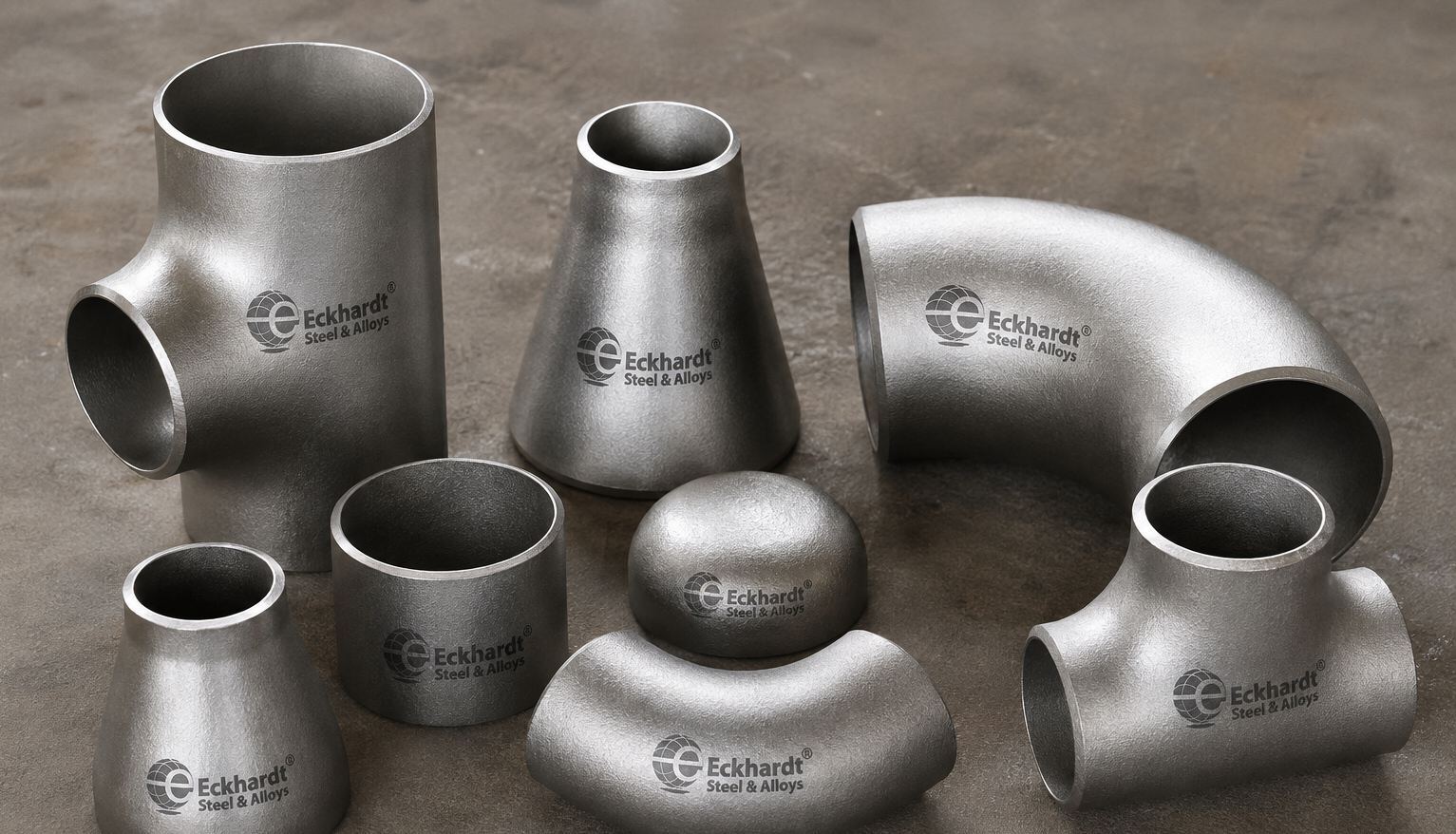
Hastelloy Elbows
Elbows change the direction of fluid flow within a piping run, most commonly at 45° or 90° angles depending on the layout.
Hastelloy Tees
Tees create branch connections where a line needs to split, available in equal configurations or reducing configurations where the branch size differs from the main run.
Hastelloy Reducers
Reducers connect pipes of different sizes, in either concentric form, which keeps a centered axis, or eccentric form, which offsets to one side for drainage or equipment alignment.
Hastelloy Caps and Stub Ends
Caps close off pipe ends entirely, while stub ends support flange connections that need to be detachable for maintenance access.
Key Hastelloy Grades Used for Pipe Fittings
Hastelloy C276
C276 offers broad corrosion resistance across a wide range of chemical environments, making it a common choice for demanding chemical-processing applications.
Hastelloy C22
C22 resists a wide range of corrosive environments as well, particularly where aggressive chemical media are part of the process stream.
Other Hastelloy Grades
Grade selection ultimately depends on the specific chemical environment, temperature, pressure, and project requirements involved, not a default assumption that one grade covers every corrosive condition.
Why Are Hastelloy Pipe Fittings Used in Corrosive Applications?
Hastelloy fittings deliver strong corrosion resistance in demanding environments, making them well suited to chemical and process applications where standard materials would degrade quickly. Performance holds up under elevated temperatures where the specific grade is rated for that service, and mechanical reliability supports the structural demands industrial piping systems place on every joint. Long-term material performance follows when the grade is correctly matched to the actual service environment, though Hastelloy isn’t resistant to every chemical or corrosive condition; the specific grade still needs to suit the specific process.
ASTM Standards and Specifications for Hastelloy Pipe Fittings
ASTM and ASME specifications are important in industrial pipe fittings because they set forth requirements that can be verified for material, size, and testing. The applicable standard depends upon the kind of fitting, the alloy grade, and the method of manufacture involved. Where applicable, standards normally used for wrought nickel-alloy fittings are used in conjunction with ASME dimensional standards for butt-weld fittings.
It is nevertheless prudent to check the exact specification against the project and procurement requirements before placing an order.
| Requirement | What to Verify |
| Alloy Grade | Required Hastelloy grade |
| Material Specification | Applicable ASTM/ASME specification |
| Fitting Type | Elbow, tee, reducer, cap, etc. |
| Dimensions | Project and applicable dimensional standard |
| Testing | Required inspection and testing |
| Documentation | Material Test Certificate and traceability |
Industrial Applications of Hastelloy Pipe Fittings
Chemical Processing
Piping systems handling aggressive chemicals and process equipment requiring corrosion-resistant materials both rely on Hastelloy fittings regularly.
Petrochemical and Refining
Process lines exposed to demanding chemical conditions and specialized piping systems requiring alloy compatibility both draw on Hastelloy fittings.
Oil and Gas
Corrosive process environments where the selected Hastelloy grade suits the specific conditions involved.
Power and Environmental Systems
Specialized process equipment, along with pollution-control and chemical-treatment systems, where applicable to the service conditions.
How to Select the Right Hastelloy Pipe Fittings
Identify the process fluid or chemical environment first, then evaluate operating temperature and pressure before selecting the appropriate Hastelloy grade. Choose the correct fitting type and dimensions, and verify compatibility with the connected pipe material. Check applicable ASTM/ASME specifications, review testing, certification, and traceability requirements, and select a supplier capable of meeting the project’s documentation requirements in full.
Important Quality and Testing Considerations
Material grade verification, dimensional inspection, visual and surface inspection all contribute to validating that a fitting fulfils its claimed specification. Chemical composition verification and mechanical testing are applied in accordance with the appropriate standard, and non-destructive testing is used when the project specification needs it. Material Test Certificates and heat traceability should be provided with every order. Not all fittings require all tests; requirements differ with the applicable standard and project specification.
Conclusion
Selecting the right Hastelloy pipe fittings for corrosive industrial systems comes down to matching fitting type, alloy grade, applicable standards, and service conditions together, not any single factor in isolation. Proper material selection at this stage supports long-term piping reliability well beyond installation. Eckhardt Steel supplies Hastelloy pipe fittings across the grades and configurations these demanding applications require.