
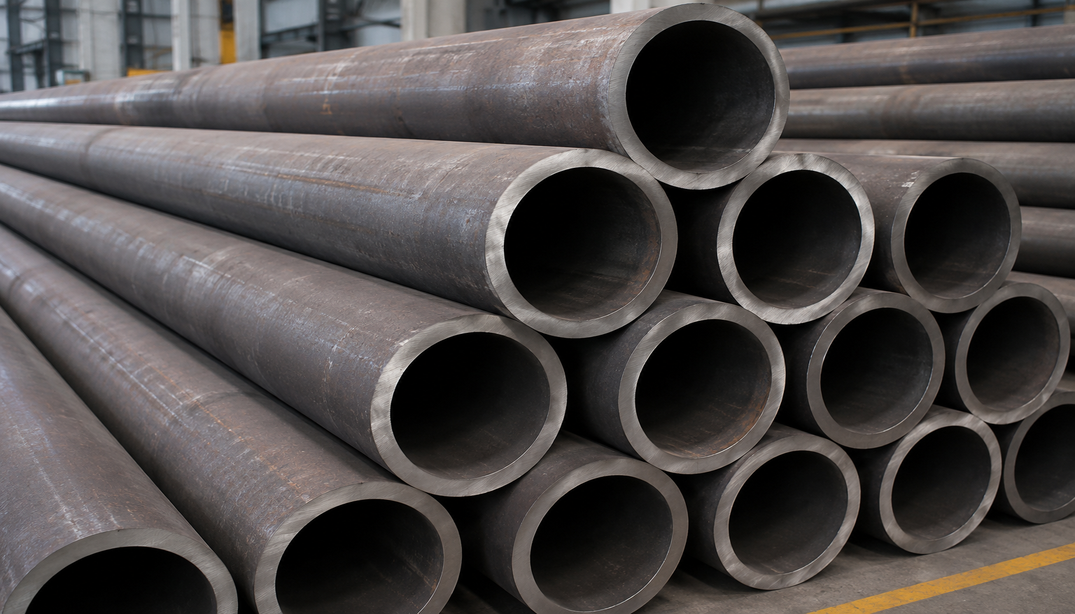
Carbon steel pipe loses tensile strength once temperatures pass 425°C and creeps faster under sustained load. An alloy steel seamless pipe solves this by adding chromium and molybdenum, raising high-temperature strength and slowing oxidation. The right grade, wall thickness, and standard decide whether piping lasts 20 years or fails within five. This article covers what alloy steel seamless pipe is, the common grades, applications, and selection factors.
What Is an Alloy Steel Seamless Pipe?
Manufacturers form an alloy steel seamless pipe by piercing and rolling a solid billet without a weld seam, then alloying it with chromium and molybdenum for added high-temperature strength. Plain carbon steel pipe lacks these elements and softens sooner. Chromium, from roughly 0.5% to 9% depending on grade, resists scaling; molybdenum slows creep. No weld seam means no built-in stress point under pressure. ASTM A335 / ASME SA335 governs this pipe type, covering grades P1, P5, P9, P11, P12, P22, P91, and P92.
Why Alloy Steel Seamless Pipes Are Used for High-Pressure & High-Temperature Service
High-pressure steam and process lines need more than a pipe that fits the schedule. Alloy steel seamless pipe holds tensile strength steady above 500°C, where carbon steel has already begun to soften. Chromium resists oxidation and scale build-up, the seamless structure withstands pressures a welded pipe cannot match, and it handles repeated thermal cycling with less fatigue cracking. That combination is why engineers specify alloy grades for severe service.
Choosing the Right Alloy Steel Pipe Grade
Grade selection should follow the design temperature and pressure of the system, not default to the highest-numbered option.
P1 and P5 Alloy Steel Pipes
P1 and P5 carry lower chromium-molybdenum content, around 0.5% to 5% chromium, suited to moderate service such as heat exchangers below 500°C.
P9, P11 and P12 Alloy Steel Pipes
These grades raise chromium content up to 9%, giving stronger creep resistance for power plant piping and refinery units between 500°C and 580°C.
P22, P91 and P92 Alloy Steel Pipes
P91 and P92 alloy steel pipe add vanadium and niobium for higher creep strength in supercritical boiler piping. Matching grade to design conditions avoids both underperformance and unnecessary cost.
Key Factors to Consider Before Selecting an Alloy Steel Seamless Pipe
Operating Temperature and Pressure
Confirm design and operating temperature first; a 25°C swing can shift the required alloy category. Match pressure needs against wall thickness.
Material Grade
Select the ASTM/ASME grade based on actual service conditions, not a generic high-temperature label.
Pipe Dimensions and Schedule
Outside diameter, wall thickness, and schedule must correspond to the pressure rating; Schedule 40 will not hold the same pressure as Schedule 80 at the same diameter.
Service Environment
Oxidation exposure, thermal cycling, and process media in contact with the wall affect service life.
Applications of Alloy Steel Seamless Pipes
Power Generation
Boilers, steam lines and superheaters use alloy steel seamless pipe for steam above 540°C.
Oil & Gas
Process piping carries high-temperature, high-pressure fluids, where seamless construction lowers leak risk at weld points.
Refineries & Petrochemical Plants
Process lines run continuously at elevated temperatures, making creep and oxidation resistance central to uptime.
Chemical & Industrial Plants
High-temperature reactors use these pipes where thermal cycling would degrade carbon steel faster, alongside fertiliser and cement plants.
How to Select the Right Alloy Steel Seamless Pipe for Your Project
Identify design pressure and operating temperature.
Determine the applicable ASTM/ASME specification.
Choose the appropriate alloy grade suited to those conditions.
Confirm outside diameter, wall thickness, and schedule.
Evaluate the service environment and expected operating life.
Verify requirements before procurement.
Choose a supplier able to provide full documentation.
Eckhardt Steel & Alloys, an ISO-certified manufacturer, exporter, and supplier of steel pipes from Mumbai, provides these grades with mill test certificates.
Conclusion
Alloy steel seamless pipe is the best metal for industrial applications where carbon steel fails, offering high temperature strength, oxidation resistance, and the ability to handle pressure in one material. Grade, size and the applicable norm must be consistent with real service condition. Choosing the right ASTM A335 / ASME SA335 grade from the beginning saves you from costly downtime. Check out the grades and specifications available in Eckhardt Steel’s product.