
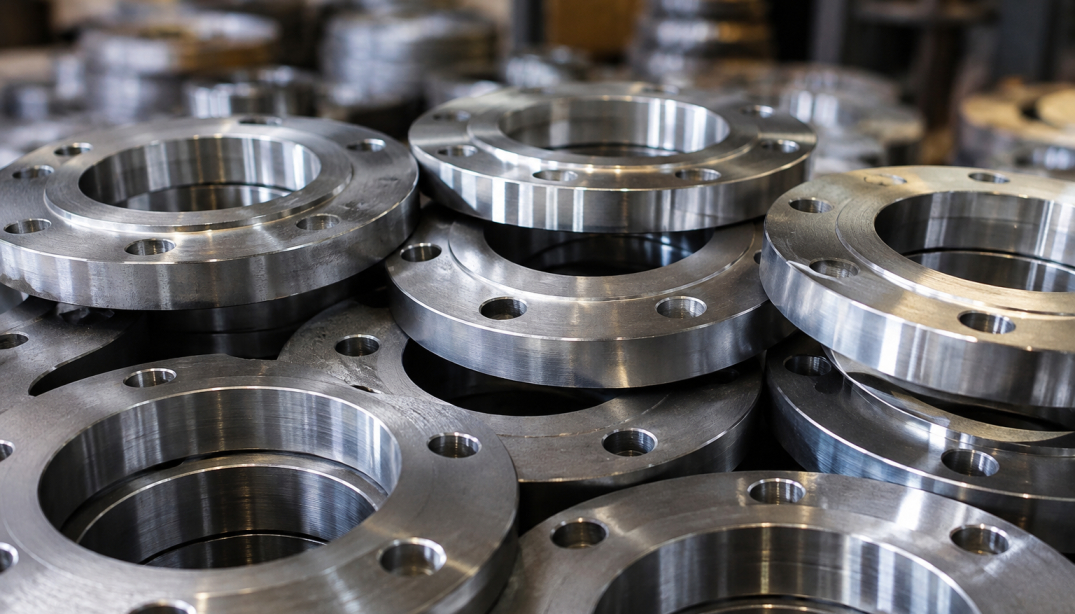
Every pipe joint relies upon the flange holding it together, and the material used in the flange determines if the joint will survive in 400°C steam service or fail after a few months. Alloy Steel Flanges and Carbon Steel Flanges remain the two most specified materials in industrial piping. This guide compares both materials, discusses the relevant ASTM grades, and lays out a practical selection process.
Understanding Alloy Steel Flanges and Carbon Steel Flanges
Alloy Steel Flanges consist of deliberate additions of chromium and molybdenum, mixed in proportions that increase the creep strength and oxidation resistance at high temperatures. These elements change the grain structure of the steel enough that the mechanical properties are stable beyond the temperature at which carbon steel starts to soften. Carbon Steel Flanges draw their strength from carbon content alone, without the elements that guard against high-temperature degradation, keeping them cost-effective within moderate temperature and pressure bands. Alloy Steel Flanges are available in grades such as F1, F5, F9, F11, F12, F22, and F91 as per ASTM A182 / ASME SA182. These grades match pipe grades P1, P5, P9, P11, P12, P22, and P91 under ASTM A335. They are designed for moderate- to high-temperature applications.
Alloy Steel Flanges vs Carbon Steel Flanges: Key Differences
Flange selection depends on eight key factors. These include chemical composition, mechanical strength, temperature resistance, oxidation resistance, pressure and thermal performance, corrosion resistance, fabrication needs, and cost. The expected service life should also be considered.
| Factor | Alloy Steel Flanges | Carbon Steel Flanges |
| High-Temperature Performance | Excellent | Moderate |
| Mechanical Strength | Higher for suitable grades | Good |
| Oxidation Resistance | Better | Lower |
| Demanding Service | Highly suitable | Application-dependent |
| General Piping | Suitable | Common choice |
| Relative Cost | Higher | Generally lower |
Alloy content becomes the deciding factor once operating temperature spikes past 425°C for continuous service, the point where carbon steel starts losing tensile strength. Chromium and molybdenum slow that loss and resist scale formation on the pipe’s internal surface. Below 425°C, Carbon Steel Flanges perform close to equivalent alloy grades at lower cost, staying the standard choice for general water, air, and low-pressure lines.
Common ASTM Grades of Alloy Steel Flanges
ASTM A182/ASME SA182 sets the specification for forged Alloy Steel Flanges, covering grades from moderate elevated-temperature duty through the highest thermal cycling service in power generation.
ASTM A182 F5 and F9
Both grades carry higher chromium-molybdenum content than F11 or F12, giving oxidation resistance suited to elevated-temperature service in reformer and hydroprocessing units.
ASTM A182 F11 and F12
These grades handle high-temperature, high-pressure service in power boilers and petrochemical process piping, balancing weldability with elevated-temperature strength.
ASTM A182 F22 and F91
F22 and F91 extend service temperature further, with F91 rated for the most demanding applications in power plant steam lines. Grade selection should follow actual operating data, not a general assumption.
Where Are Alloy Steel Flanges Used?
Power Generation
Steam headers, boiler piping, and turbine connections operate at temperatures where grades such as F11 and F22 outperform carbon steel.
Oil & Gas
High-pressure process and transmission piping benefit from the strength alloy steel retains under sustained load.
Petrochemical & Refining
Reformer units and high-temperature process lines use Alloy Steel Flanges at connection points exposed to continuous thermal cycling.
Chemical Processing
Process lines carrying corrosive or high-temperature media rely on alloy grades where mechanical performance under sustained heat matters more than material cost.
How to Choose Between Alloy Steel and Carbon Steel Flanges
Confirm operating temperature and pressure for the line first, as both numbers impact whether carbon steel is sufficient, or an alloy grade is required. Check the process medium next, since corrosive or high temperature service limit the options towards a specific alloy grades. Determine the applicable ASTM/ASME specification, then compare flange type, pressure class and dimensions with standard such as ASME/ANSI B16.5, B16.47 and B16.36. Material documentation and traceability to be verified before order closure
Conclusion
Carbon Steel Flanges are a practical choice for general piping at moderate temperatures and pressures. In demanding conditions, Alloy Steel Flanges in grades such as P11, P22, and P91 offer better high-temperature strength and oxidation resistance. Always select the flange grade based on operating temperature, pressure, and service conditions, not price alone. For grade-specific specifications and pressure classes, explore Eckhardt Steel’s Alloy Steel Flanges range.